Copyright The Design Chaser 2012. Powered by Blogger.

Search Bar

Social Media

Text Space

THE DESIGN CHASER

de l'Épée Residence by Michael Godmer Studio

1.20.2026

Some projects begin with a brief. This one began with a conversation. When Michael Godmer Studio was first contacted, the clients had already lived in the house for several years. The call was exploratory — an open exchange of ideas rather than a defined request. The couple — an art therapist who works intuitively with the body, gesture, and emotion, and a social programmes manager focused on building sustainable human structures — had lived internationally, gathering cultural and spatial experiences that would contribute to the narrative of their home in Montreal.


Their return to Canada was a way to reconnect with family, to offer stability for their two children, while preserving the openness shaped through travel. What began as a conversation soon evolved into a full renovation, developed patiently over time, with Michael Godmer Studio guiding the process and assembling a network of local artisans and collaborators around a shared vision.


Even before construction began, the house became a kind of laboratory. Drawings appeared on walls and family-made artworks acted as spontaneous gestures that inscribed the family’s identity into the space. From the beginning, the intention was clear: to create a home that felt singular and expressive, far removed from standardised imagery, and deeply attuned to colour, theatricality, and a vibrant family life.


The house already carried a rich history. A character-filled residence in Outremont, it was defined by warm woodwork and material depth, generous proportions, and a central staircase that anchored the plan. Rather than erase these elements, the design sought dialogue. The staircase was preserved exactly as it was, acting as a point of balance between past and present. Elsewhere, interventions extend the architecture rather than replace it — rounded door frames, reconfigured openings, and redesigned windows soften transitions and introduce a sense of flow.


Function and family life shaped every architectural decision. This includes working from home, with a dedicated art therapy space integrated seamlessly into the domestic flow, and an upstairs office offering focus and retreat. Cabinetry takes the place of traditional partitions, defining zones and creating versatile spaces. Custom doors, in particular became a central design element: glazed wood-framed, solid bespoke designs and louvered wardrobes were developed in close collaboration with local artisans. Each one is functional, tactile, and quietly expressive — part of a broader commitment to craftsmanship and personalisation.


Throughout the house, the atmosphere shifts gently from one zone to the next: a theatrical powder room in soft pinks nodding to the world of Wes Anderson, vibrant and playful spaces for the children, and, in contrast, the parents’ wing — calmer and more sensual, where bedroom and bathroom engage in a quiet, intimate dialogue. Each variation feels deliberate, responding to mood, function, and the rhythms of daily life.


Materiality is layered with restraint. A warm, mayonnaise-toned base colour envelops the home, allowing preserved woodwork to sit comfortably alongside brushed lacquered woods, uniform lacquer finishes, Botticino Fiorito marble, and travertine flooring. Limewash paint introduces sandy textures that interact with sculptural and decorative elements, referencing the clients’ travels and eclectic sensibilities.

Curves are a recurring element throughout the house, softening the lines of the kitchen island, door frames and bathrooms and creating a fluid language that resists being fixed in time. The kitchen itself is restrained and abstract, avoiding overt references — particularly to the French bistro — through a subtle repetition of tile lines between floor and island. One of the project’s signature details — which immediately caught my eye — is the narrow-plank white oak floor, recalling the home’s origins, framed by a tiled border that echoes the kitchen. A single small tile marks the transition between wood and ceramic, a detail repeated throughout the house, forming a discreet narrative thread.


Lighting is intentionally understated, designed to reveal textures and materials rather than competing with them. Sourced largely through local collaborations, it contributes to the home’s sensitive, coherent and deeply personal composition.


More than anything, this is a project shaped by relationships — between a family and their home, between past and present, between architecture and craftsmanship. It has been designed to evolve, welcome, and grow richer over time, without ever losing its soul.


Photography by Maxime Brouillet

VIEW STORY
Pin ThisShare on Tumblr

A Paris Home Shaped by Wood and Light

11.24.2025

With their latest project, German design studio Holzrausch brings a sense of calm to a vibrant Paris neighbourhood. The award-winning studio has created a retreat that also serves as a tribute to woodworking — fitting, given their beginnings as a modest workshop before expanding into interior design. Set in the bustling, densely populated 11th arrondissement, the family home becomes an unexpected oasis, a quiet composition in wood that gently contrasts with the world outside.

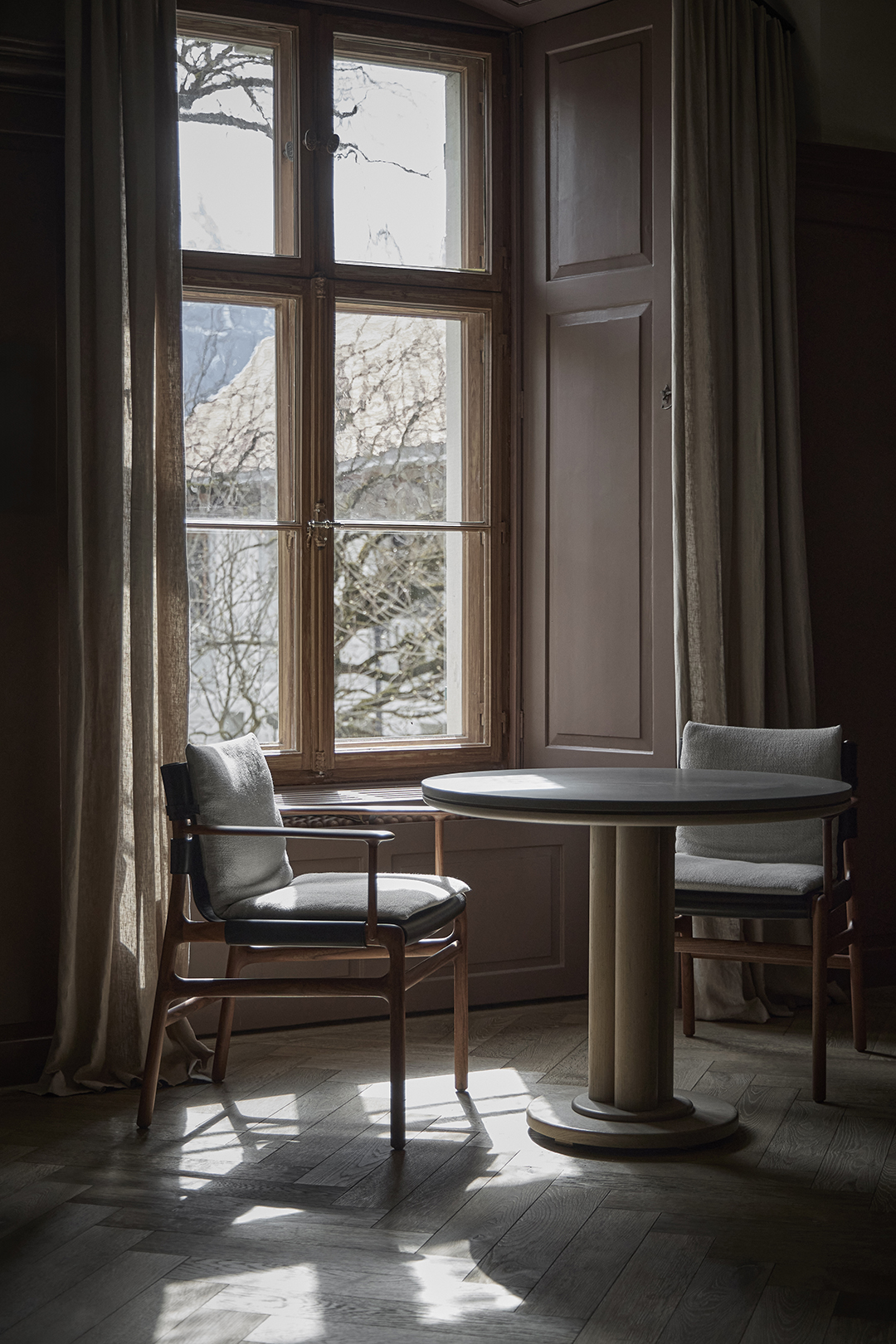
The owners wanted an interior defined by calm and simplicity, deliberately avoiding anything trend-led or Instagram-driven. “As a former model and gallery owner and a creative himself, the client was naturally drawn to our focus on material quality and restraint,” explains Petri, cofounder and design lead at Holzrausch. Despite their deep connection to the art world, the owners requested that nothing disturb the stillness of the space — no decorative elements, no artwork.


Located behind a closed gate and down a winding path through a long courtyard — ending in a lovely garden — the home’s harmony comes from its tight palette of materials: oak, plaster, stone, and stainless steel in the kitchen. Every design element is intentional, balancing functionality with a desire to let the materials take centre stage. Lighting is fully recessed, most of the furniture is built-in, and appliances are hidden behind wooden doors. 


While the original concrete floors were retained, the façade and skylights are new — essential additions given that all windows in the L-shaped building face the courtyard. Bringing natural light in from above became a defining consideration and informed the sculptural staircase. Crafted from wood that matches the oak used for the wall panels and furniture, its form helps distribute light across all levels.


The house spans four floors, including a small basement, totalling around 3,800 square feet, and includes a private garden at the entrance. Its central feature — the undulating staircase — acts as the home’s spine, introducing natural light from the skylight above. In warm weather, doors open to the garden, subtly shifting daily life toward indoor–outdoor living. Craftsmen from several countries contributed to the project: plasterwork from Italy, massive oak floors from Denmark, and lighting also from Denmark.


After expanding from a woodworking workshop into interior design, Holzrausch  eventually unified fabrication and design under one roof. “Many clients come directly to us because the distance between design and fabrication is extremely short,” says Petri. He describes the studio as simultaneously interior designers, interior architects, and master carpenters.

“Our philosophy has always been simplicity, minimalism, and timelessness — this project reflects that completely,” he adds. “The name ‘Holzrausch’ is difficult to translate. It expresses a fascination with materials — wood among them, but not exclusively — and that mindset is visible throughout the project.”


Credits

Interior Design: Holzrausch Studio
Photography: Salva López

VIEW STORY
Pin ThisShare on Tumblr

The Dinesen Apartment by David Thulstrup

10.10.2025

Dinesen, Denmark's leading manufacturer of high-end wooden flooring, has unveiled the Dinesen Apartment by David Thulstrup in Brooklyn, New York — a temporary showroom and immersive space designed by acclaimed Danish architect David Thulstrup. The apartment will be open until February 2026, offering visitors a unique opportunity to experience Dinesen wood in an intimate and beautifully curated residential setting.


Dinesen Apartment by David Thulstrup moves beyond traditional showroom displays, instead presenting Danish design within a carefully curated living space that captures the poetic essence of Dinesen wood.

"Everything I design is about crafting a sense of place," said Thulstrup. "The apartment is not just about showcasing materials — it's about evoking emotion through scale, light and texture. Dinesen's wood, grown over decades, carries a quiet power. This project allows visitors to feel that in a completely immersive way."


Located across the 1st and 2nd floors of 144 Vanderbilt Avenue, a thoughtfully designed building by SO—IL, and developed by Tankhouse, the project highlights the seamless integration of architecture, interiors and craftsmanship. Tankhouse’s contractor and developer role ensured the building became a complementary canvas for presenting Dinesen in a warm, homely context.


The pop-up showroom marks Dinesen’s first spatial venture in America. It is the brand’s second apartment concept, following the celebrated launch of the Dinesen Apartment by John Pawson at the Copenhagen showroom in 2024.


At the heart of the space is Dinesen Layers Oak in the Classic variant, chosen for its calm elegance and engineered stability. Seamless surfaces unify the interior, while select uses of Layers HeartOak add depth and character with natural cracks held by oak butterfly joints. The wood extends to cladding and a bespoke staircase in Layers Oak, a built-in bookcase in solid Oak Classic and a solid HeartOak headboard, creating a warm, continuous visual language.


The interiors are furnished with a curated mix of David Thulstrup's designs, including the Arv Collection for Brdr. Kruger and pieces by John Pawson for Dinesen. Thulstrup chose the upholstery made of Levino fabric by Sahco.

"I like to layer different timelines and characters — contemporary, classic, and crafted," said Thulstrup. "The overall mood is quiet and grounded. I wanted the atmosphere to slow down time."

Danish vintage pieces by Arne Jacobsen and Severin Hansen, by Dagmar, lend a historical layer to the space.

“We hold deep respect for materials, traditions and craftsmanship from the golden era of Scandinavian design,” said Dagmar. “We proudly share these values with Dinesen and David Thulstrup and contribute to this collaboration with reissued furniture by Danish icon Severin Hansen.”


Every element of the apartment reflects Dinesen's dedication to quality and craft. The Danish carpentry duo Ocular installed the flooring and carried out the meticulously crafted joinery details, from the half-turn staircase, wall-claddings and doors to the built-in furniture. Walls are painted in Titian, Sand and Suede, developed by David Thulstrup for Bleo. Their nuanced pigments complement the warmth of the wood and the natural light. Softness and texture are thoughtfully layered throughout the apartment, with rugs, drapery, upholstery, bedwear, blankets, towels and bathmats from Kvadrat, Sahco and Magniberg.

The finishing touches include Penumbra, a sculptural hollowware piece by David Thulstrup for Georg Jensen, and door handles from FSB, further emphasising the story of material sensitivity and Danish design heritage.


Beyond being a showroom, the Dinesen Apartment by David Thulstrup is a working residence, event space and meeting hub. It invites guests to experience Dinesen in context — light steps on Oak floors, conversations around handcrafted furniture and textures felt with the whole body.

"In an age of hyper-visual design, we wanted to offer something deeper," said Thulstrup. "Spaces should be sensed, not just seen. This apartment is an invitation to connect with materials in a way that photography alone can't convey."


Dinesen Apartment by David Thulstrup will be open by appointment until February 2026.
Schedule a visit here.

Photography by Eric Petschek

VIEW STORY
Pin ThisShare on Tumblr

Space Copenhagen Thoughtfully Reimagines Schloss Schauenstein

7.30.2025

Nestled in the heart of the Swiss Alps, Schloss Schauenstein has long been a destination for culinary excellence under the vision of three-star Michelin chef Andreas Caminada. In celebration of the restaurant’s 20th anniversary, the interiors of the 12th-century castle have been thoughtfully reimagined by the acclaimed Danish design studio Space Copenhagen. The result is a delicate dialogue between past and present, where heritage and craftsmanship intertwine, and where guests are invited to savour not only Caminada’s celebrated cuisine but also the sensory experience of the castle itself.


Schloss Schauenstein’s ivy-clad stone façade rises from the mountains of Fürstenau, Switzerland, steeped in centuries of history. As guests arrive, they’re met by crisp alpine air, scented with pine and woodsmoke—setting the tone for the experience ahead. Crossing the threshold, they step into a world where ancient stone walls, timber beams, and winding staircases are thoughtfully balanced with soft, natural materials including oak, stone, wool, and linen. The lobby introduces Space Copenhagen’s restrained and elegant aesthetic: timeless furniture pieces from Studio Oliver Gustav, including a stone side table by Maverick Lee and a brass table lamp by Michael Verheyden, sit in quiet conversation with the castle’s original architecture, offering a sense of both intimacy and grandeur.


At the heart of Schloss Schauenstein, the dining room is an intimate, evocative space, softly lit to cast shadows that move gently across textured walls. The atmosphere exudes a calm sense of anticipation, allowing guests to fully immerse themselves in Caminada’s culinary vision. Tableware, cutlery, and bespoke furniture—crafted by local artisans using wood and stone—reflect the same attention to detail and commitment to craftsmanship. Custom Sela dining chairs from De La Espada, upholstered in a distinctive blend of wood, leather, and textile, complement the refined yet grounded setting.


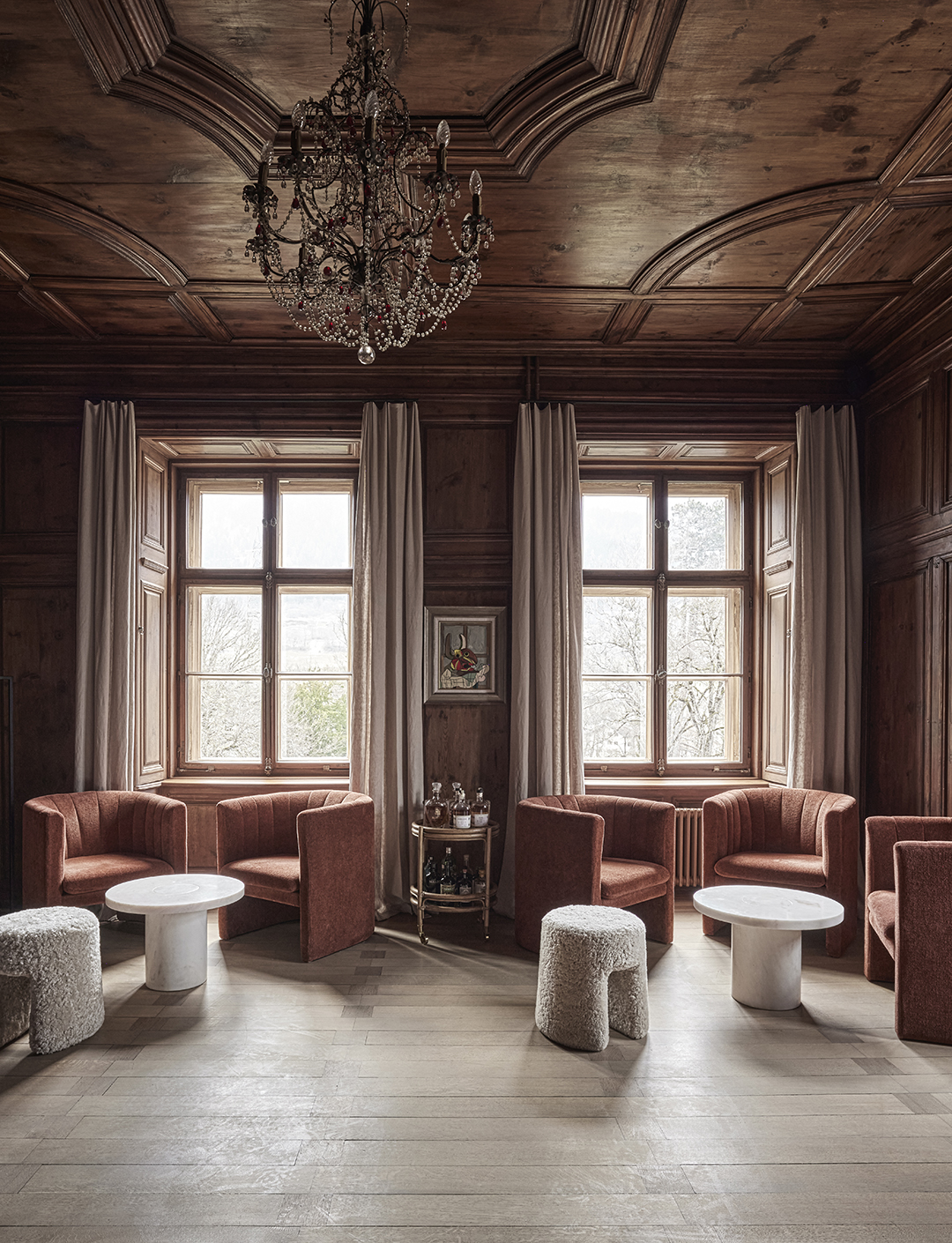
In the Chimney Room Bar, warm rust tones create a cocooning atmosphere, complemented by Space Copenhagen’s Loafer sofas for &Tradition, the Stay Chair for Gubi, and Frama’s Sintra Stone Lounge Tables. Throughout the interiors, vintage pieces salvaged from the castle have been upcycled and reupholstered, seamlessly integrating with more contemporary designs to create a layered, cohesive narrative.


The redesign of Schloss Schauenstein is a testament to the collaborative vision between Caminada and Space Copenhagen—a shared commitment to honouring the spirit of place while creating a timeless, sensory experience.

“Having worked with Space Copenhagen for our boutique hotel and restaurant Mammertsberg, it was clear to me that they were the perfect people to bring the castle into its next era,” says Caminada. “My wife Sarah and I wanted to create the perfect harmony between tradition and modernity, blending timeless design classics into the fabric of the castle.” He continues: “To me, experiencing the castle’s spirit and feeling its history has been crucial in planning the renovations for our 20th anniversary. Guests should feel at home in every corner and enjoy both the culinary journey and the castle with all their senses.”

The redesigned guest rooms provide a sense of stillness and retreat. Each room is distinct, yet all exude an understated elegance. Original stone and timber-clad walls anchor the spaces in their medieval heritage, while natural materials—oak, soft wool, and linen—introduce a contemporary warmth. Earthy tones reflect the surrounding alpine landscape: soft greys, burnt orange, forest greens, and warm neutrals.


Furniture has been carefully curated and crafted: vintage pieces from the castle restored alongside iconic designs from B&B Italia, Cassina, and Bonacina, as well as bespoke additions by Space Copenhagen. The lighting is soft and atmospheric, changing with the time of day to cast shadows across the textured walls. Large windows frame views of the valley and the cobbled village below, blurring the boundaries between inside and out. Bathrooms, finished in stone with minimalist fixtures, invite quiet reflection, featuring rainfall showers and deep soaking tubs that enhance the sense of calm.

Signe Bindslev Henriksen, co-founder of Space Copenhagen, comments “Each room is a study in understated elegance, deliberately stripped of excess to let the architecture, and the guest’s own experience, breathe. No two rooms are the same; each offers its own sense of place.”

Peter Bundgaard Rützou, co-founder of Space Copenhagen, adds “There’s a rare stillness to the rooms. They offer different forms of respite, but all share a sense of comfort, privacy, and connection to the landscape. We hope guests feel less like they’re checking into a hotel and more like they’re being welcomed into a thoughtfully curated retreat.”


Space Copenhagen’s sensitive design approach invites guests to experience Schloss Schauenstein as a living, breathing place—where the past is honoured, the present savoured, and the future thoughtfully imagined. Every detail, from the softly worn stone floors to the carefully curated furniture, reflects a deep respect for craft, material, and context. This isn’t just a renovation—it’s a quiet reawakening. A layered collaboration between architecture, design, and gastronomy. Together, Andreas Caminada and Space Copenhagen have created an experience that feels timeless yet deeply personal—an immersive experience where heritage and hospitality, nourishment and nature, memory and modernity seamlessly converge.

Credits

Photography: Joachim Wichmann

VIEW STORY
Pin ThisShare on Tumblr
 

T.D.C© Theme by Blog Milk